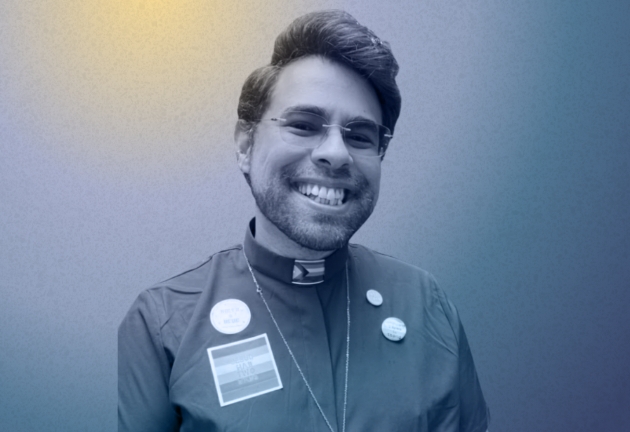
Chris Kanowitz
After years of formation and ordained ministry, Chris Kanowitz found himself searching for a way to serve with greater integrity…

In 2002, attorney and biblical studies professor Jane Via read about the Danube Seven and felt called to help move the Church forward in the inclusive spirit of Vatican II. Victoria Rue, a playwright and lecturer in comparative religions, creative arts, and women’s studies, found herself beckoned by a similar call. Their paths converged in June 2004 when Jane and Victoria were ordained deacons on the Danube River.
—
In 2002, Jane Via, an attorney and part-time professor of religious studies at the University of San Diego, encountered an article in the San Diego Union-Tribune that captured her attention. The Vatican had just excommunicated seven women ordained on the Danube. Seven Catholic women were ordained priests!
From the time she was a child, Jane experienced a deep call to Catholic ministry. Studying, teaching, and leading ministries, Jane spent years serving the church in the spirit of the open, evolving ways of Vatican II. And yet, like many of her contemporaries, she found herself persisting in hope for change while institutional powers quietly withdrew from Vatican II’s promises. For remaining faithful, she paid a steep price.
The moment she learned about the Danube Seven, she finally had an answer to long-held prayers. She knew what she could do to help the church move forward. She could follow in their footsteps.
With persistence, Jane connected with the Danube Seven a year later and presented her credentials. In 2004, she and her husband, Phil Faker, traveled to Passau, Germany. In the third-ever RCWP ordination, Bishops Christine Mayr-Lumetzberger and Gisela Forster ordained her a deacon on the Danube River, alongside 5 other women: Astride Indrican of Latvia, Michele Birch-Conery of Canada, Geneviève Beney of France, Monika Wyss of Switzerland, and Victoria Rue, a fellow Californian. Because her younger son was still a student in a Catholic high school, Jane was ordained using the catacomb name of Jillian Farley.
Read more of Jane’s story here.
Hear Victoria tell her story, here:
“This, then, is a vision of not just adding women and pouring women into cassocks. This is a vision of theology changing, liturgy changing, language changing… and shared leadership.” -Victoria Rue
– – –
What they are saying to us to justify the exclusion of women to be priests is simply Jesus chose only men as apostles. However, they leave out the very heart of Christianity, the resurrection. Jesus rose from the dead. The first person that Jesus appeared to after the resurrection was a woman, Mary Magdalene. And actually Mary Magdalene later became known and referred to as the apostle to the apostles. This they leave out.
The Vatican hierarchy maintains that women have never held important leadership roles in the church. But new scholarship points to the existence in early times of female apostles, deacons, priests, and even bishops. In light of this new evidence, a very different picture of the infant Christian church is emerging—one in which women played a vital role.
There is, and the church just doesn’t deal with this, in the Bible an apostle named Junia. Paul says the apostle Junia. We have archaeological evidence of women vested, celebrating mass. The level of denial is astonishing to me.
Well, first of all, the church does not base its doctrine on archaeology, because you don’t really know what you’re digging up—you know, if you’re digging up the truth or a falsehood.
My specialization was in scripture. And my professor said, “Well, if you want to study scripture, you’ve got to learn archaeology. You’ve got to go to the Holy Land. You’ve got to study archaeology and history and ancient languages and get a firm foundation in what life was really like back then.” Catholic theologian and archaeologist Dr. Dorothy Irvin has spent the past four decades studying the early history of Christianity.
Through careful re-examination of ancient artifacts uncovered in the Holy Land during the past century, Dr. Irvin and other scholars are discovering strong evidence of women in leadership roles in the burgeoning church. We have written manuscripts, reports on councils, writings of early theologians. We have lots of tombstones of women who were priests. There are mosaics either on walls or on the floors of cathedrals.
One really nice mosaic is on the floor of the cathedral where St. Best was bishop in Hippo in North Africa. And this is the burial inscription of a woman named Julia Runa Presbyterissa—Julia the woman priest right there in Hippo. And Augustine is usually thought of as being so against women, and yet he apparently had them on his staff ordained. We have pictures in the catacombs of women who were being ordained—two catacomb paintings of women celebrating the Eucharist, and that for us today is definitive for the priesthood.
The Eucharist or Holy Communion is the central Catholic ritual that commemorates the last supper of Jesus. The faithful partake of the bread and wine which has become the actual body and blood of Jesus through the consecration by the priest. The only minister of the Eucharist is a validly ordained priest who is seen to act in the person of Christ. Women have a feeling that they’re called and history supports this feeling. It’s in accordance with very early teaching and practice when people were much closer to the original message of Jesus than we are now.
Over time, other voices began to dominate and drown out the inclusive teachings of Jesus. The writings of Timothy, Tertullian, and Thomas Aquinas denounced leadership by women and reasserted deeply held cultural prejudices that women were inferior to men, both by nature and by law. Ordination of women was banned in four councils over 100 years, indicating that it was a difficult practice to stamp out. And when Christianity became the official religion of the Roman Empire, evidence of women’s roles in the early church was all but eradicated.
I’ve been looking forward to talking with all of you for weeks now. So very happy to be here.
So what does a 21st century Roman Catholic woman priest look like? Not like this. You see, we don’t really want to be poured into cassocks or fine royal robes. Women priests are not copies of male priests.
Let’s take a look at this slide. This is Cardinal Burke. We’re not interested in the brocades, in the long beautiful dresses, or even that lovely hat. What we are interested in is understanding that you can’t just add women and stir.
So I thought today it might be interesting to share a little bit of my story with you and that way you could perhaps understand how a Roman Catholic woman priest becomes. How does she become called? Who is she?
So here’s a bit of my story. Ever since I was a little girl, I wanted to be a woman priest. Now, I would invite the neighborhood kids to our house and I would hand out these lovely little Necco wafers to them. You know the ones, right? I’d have them kneel on the front step and put the Necco wafer onto their waiting little tongues, right?
Well, much later I realized that I wanted to dedicate my whole life to God. And the only way I knew how to do that as a Roman Catholic woman was to become a nun. So I entered the convent for one brief year. It was beautiful, but I understood that this was not my calling.
Some years after that, 1985, I went to Union Theological Seminary. Now, this is an interesting word, seminary. Language is important. I prefer to use the word ovular. So, I went to Union Theological Seminary and I went there to receive a degree called Master of Divinity. I prefer to say mistress of divinity, an M diva, if you will. Now, I know that sounds funny, but language is important.
So, while I was there, I studied liberation theology. I studied feminist theology and even lesbian theology. And I began to hear again the voice of God calling me to be a priest.
Fast forward now to 2002, and I read that seven women were ordained on the Danube in Europe by three male bishops, and I knew immediately that my prayers were answered. So in 2005 on the St. Lawrence Seaway on a boat I was ordained by three women bishops. I must tell you it was an extraordinary day where I really felt the spirit present palpably.
Well, I have to ask then, what does a feminist Roman Catholic woman priest look like? Ah, this is better. Something simple, something flowing, something that catches the air, something that moves with the body.
Ah, the body. The body, you see, has been put in the closet by the Catholic Church for centuries, including sexuality. Particularly, women’s bodies have been put in the closet because women’s bodies, you see, have represented sinful Eve. So, let’s cover them up. Women’s bodies have represented sex, lust, earthiness, and this must be very embarrassing to a patriarchal father god.
But you see, feminists and feminist women priests don’t believe in that kind of a god. We believe in a god who loves all of creation, not just some of creation. We believe in a God who is a God of the poor, justice for the poor, a God who believes in equality for all. This God, this beautiful God looks at the Roman Catholic Church today and sees what a mess it is led by male clergy and is calling women priests to help clean up the mess. Now, we’re not the solution, but we’re part of the solution.
And when the Vatican says to us today, “Well, you know, Jesus was a man and therefore only baptized men can be ordained,” well, we say, “Well, that must mean then that male priests should all be Jewish and they should all be carpenters.” Or when the Vatican says to us, “Well, there were only 12 male apostles,” we say, “No, that’s just not true. There were women disciples and apostles.”
So, you see, this is a very different church that we’re talking about. We’re talking about a church of the women mystics: Hildegard of Bingen, Catherine of Siena, Sor Juana de la Cruz. We’re talking about a church of the women martyrs in Juárez—those women who are murdered every year and who our hearts bleed for. We’re talking about the martyred women of El Salvador. This is the church also where women manage and make the decisions for their own bodies, not a church where men are making those decisions for women’s bodies.
So Jesus, you know, we think was married. Well, we’re not sure. But we do know that there are 12 male apostles and mostly all of them were married and therefore women priests should be married, and so we are single, and so we are celibate if they choose to be, heterosexual if they choose to be, lesbian if they choose to be, partnered, unpartnered. You get the idea.
So this then is a vision of not just adding women and pouring women into cassocks. This is a vision of theology changing, liturgy changing, language changing.
I’d like to show you what a feminist mass looks like. It’s very important that we have shared leadership. And so this stole, which is very simple, is a very important symbol, and in our feminist mass everyone who takes a leadership role wears this stole. Shared leadership is essential.
It’s also essential in a feminist mass that we use inclusive language. There are many names for God—not just father, but mother, holy one, beloved friend, sacred energy of the cosmos. In addition to inclusive language, we also have shared leadership as I’ve said. So we call ourselves a community of celebrants.
And I’d like to show you what that looks like. We sing joyously with each other. We bless each other. There are all ages present. We all say the words of consecration of the bread and wine, not just the male priest saying those words. We serve each other communion and then we sit down and we all eat together.
At Sophia in Trinity, we are a diverse community of Catholics. We welcome everyone to the table and we use embodied prayer.
And so let me offer a prayer for you and also for our troubled world: Come Holy Spirit, fill the hearts of your faithful. Enkindle in us the fire of your love. Send forth your spirit and renew the face of the earth. Now without words.
Amen. Thank you.