Chris Kanowitz
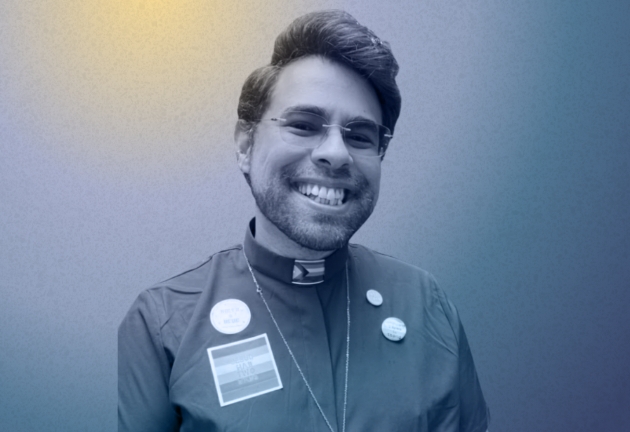
After years of formation and ordained ministry, Chris Kanowitz found himself searching for a way to serve with greater integrity…

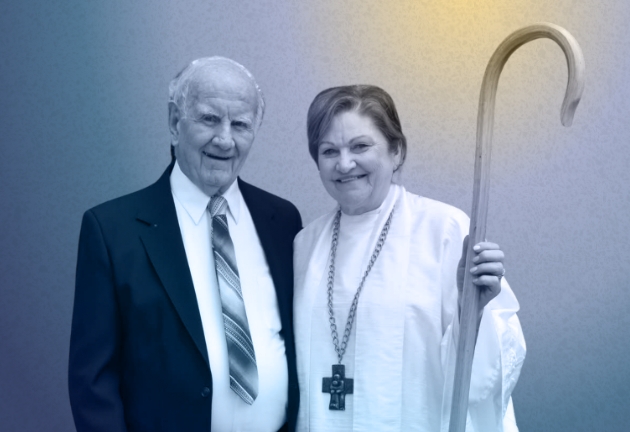
Jane Via spent decades advocating for radical inclusion, only to face censorship and barriers from church hierarchy. Discover how a spark ignited by the historic Danube ordinations transformed her grief into action, leading her to break canonical boundaries and co-found a thriving, inclusive parish.
—
From the time she was a child, holy curiosity beckoned Jane Via to an ever deepening devotion to the sacramental life of the Catholic Church. Her sharp, inquisitive intellect guided her from undergraduate studies toward graduate work in theology and biblical studies, and later a doctorate in law. After completing her PhD in Religious Studies in 1976, she turned her work to teaching religious studies, first at Mercy College of Detroit and then at the University of San Diego (USD).
As a New Testament scholar, she became attuned to the ways Jesus practiced radical inclusion, and was inspired to do the same. Beckoned by Love and guided by the spirit of Vatican II, Jane nurtured her local Catholic communities, developed inclusive faith language resonant with the many beyond-gender images of God in the Bible, and rendered biblical texts informed by their historical and linguistic contexts so that modern listeners might engage more deeply with their original meaning.
Rather than fostering her gifts, clerics and administrators watched her with suspicion, criticized her conscientious actions, and constructed more barriers. In 1984, she signed her name to a New York Times ad asking only for open conversation about abortion in the Catholic Church. Her bishop, Leo T. Maher, demanded she recant. When she declined, he barred her from teaching in any Catholic forum, on any subject – an extremely painful act of exclusion. (Thankfully, this censorship ended with Maher’s death, after which, she taught part-time at USD again.)
Through it all, Jane never stopped teaching or using her voice, though the rooms may have changed. Still, grief and disillusionment slowly eroded her hope in the changeability of the church. She had done everything she knew to help the church live into the promises of Vatican II, even while perceiving the quiet, but real retraction of its evolving and open theology. She had struggled with what else might she do to help move the church forward….
That is, until 2002, when news reached her that seven women had been excommunicated for being ordained on the Danube. The flame within her reignited. After months of praying with a question she carried home from an encounter with the Immaculate Heart Community: “what can you do to help change the church?” Jane suddenly had her answer. She could be ordained. Not only did she have the theological background, but she also had earned her law degree, and was well-readied to engage on the topic of Roman Catholic injustices rooted in canon law.
It took her over a year to find a way to communicate with the Danube Seven, but she succeeded.
After providing proof of her educational requirements, she was accepted for ordination to the diaconate. In 2004, Jane traveled to Passau, Germany, accompanied by her husband, Phil Faker. In the third-ever RCWP ordination, Bishops Christine Mayr-Lumetzberger and Gisela Forster ordained her a deacon on the Danube River, alongside 5 other women: Astride Indrican of Latvia, Michele Birch-Conery of Canada, Geneviève Beney of France, Monika Wyss of Switzerland, and Victoria Rue, a fellow Californian. Because her younger son was still a student in a Catholic high school, Jane was ordained using the catacomb name of Jillian Farley.
Jane co-founded the very first Roman Catholic Womenpriest-led parish in the United States, Mary Magdalene Apostle Catholic Community, in San Diego, which is still thriving.
—
Learn more about Jane’s Via story in her biography, Empty Shoes in the Vatican, by Lisa K. Shapiro.