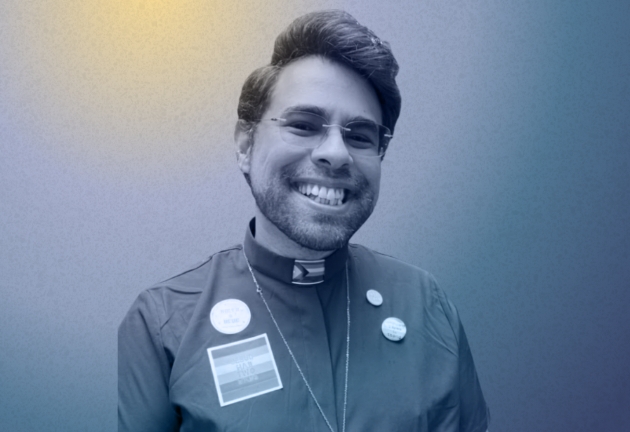
Chris Kanowitz
After years of formation and ordained ministry, Chris Kanowitz found himself searching for a way to serve with greater integrity…

On June 29, 2002, seven women were ordained to the priesthood by Bishop Rómulo Antonio Braschi on the Danube River in deliberate challenge to Canon Law 1024, which unjustly limits ordination to baptized males.
—
Jesus called women into ministry from the beginning. He commissioned Mary Magdala to spread the news of his resurrection, to become apostle to the apostles. In the early Church, Phoebe served as deacon of the church at Cenchreae, entrusted by Paul to carry his letter to Rome. Junia was named outstanding among the apostles. Prisca taught alongside her husband, teaching men and women in the way of God. And yet, by the hand of time and the will of patriarchy, their contributions to history were suppressed.
On June 29, 2002, the Feast of Sts. Peter and Paul, an act of prophetic obedience called the world to remember. On a chartered boat sailing the Danube River near Passau, seven women who had been preparing for years – Iris Müller, Ida Raming, Pia Bruner, Dagmar Celeste, Adelinde Theresia Roitinger, Gisela Forster, and Christine Mayr-Lumetzberger – knelt before Bishop Rómulo Antonio Braschi, with Bishop Rafael Regelsberger in witness, and were ordained to the Roman Catholic priesthood. They became known as the Danube Seven.
The Vatican responded with warnings, followed by excommunication on the Feast of Mary Magdalene. The crime? The women knowingly broke canon law 1024, which says only a baptized male can be ordained. But the Holy Spirit finds ways where the law of men restrains.
One year later, Vatican bishops in good standing, whose identities remain protected, ordained two of the seven (Christine Mayr-Lumetzberger and Gisela Forster) as bishops in apostolic succession, to ensure that the ordination of Roman Catholic women would not end with the Danube Seven. It would begin.
It is this lineage that continues with us, everywhere the Spirit finds a “yes.”
Ida Raming and Iris Müller, having advocated for women’s ordination for more than 40 years as theologians, and having profoundly suffered at the hands of institutional misogyny, wrote the following after being ordained:
Women priests (excerpt from Contra Legem)
We have crossed a threshold
We have overcome a barrier –
A barrier inscribed: “Women must not trespass…!”
We have opened a door inscribed: “No entry for women!”
We have jumped the role – imposed on women by men,
We have violated a law that keeps women down…
Now we stand beyond the barrier, beyond the door, beyond the law…
We testify:
Women are called by God to be priests,
Women have received the gift of the freedom of the ‘children of God’
Women, as free humans, may raise their heads…
—
Ida Raming and Iris Müller tell their stories in “Contra Legem”- A Matter of Conscience: Our Lifelong Struggle for Human Rights for Women in the Roman-Catholic Church.
You can read other stories of the Danube Seven via the expansive archives at the Wijngaards Institution for Catholic Research: Ida Raming, Iris Muller, Christine Mayr-Lumetzberger.