Eillen DiFranco
This interview was first printed in the Southeastern Pennsylvania Women’s Ordination Conference’s publication, “Equal wRites” in 2010, four years after…

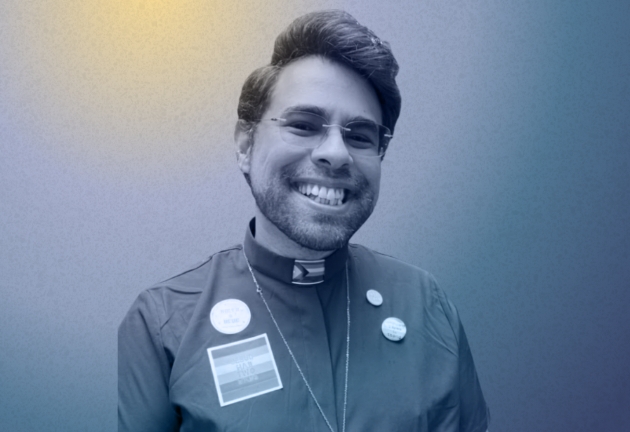
After years of formation and ordained ministry, Chris Kanowicz found himself searching for a way to serve with greater integrity and compassion. His story is one of transformation, reminding us that God’s call often leads beyond familiar boundaries and into communities where everyone is truly welcome.
—
One day, when I was in the 6th grade, one of the other kids in my afterschool program started a club. It was called “The Cool Kids Club” and she only invited a few to join. Anyone else, myself included, who inquired about joining this most exclusive of clubs (which was a table covered in blankets, like a small fort) was summarily told we weren’t cool enough and dismissed. But rather than sulk at my rejection, I decided to start my own club. I called it the “Everyone is Welcome Club” and it wasn’t hidden under a table, but out in the open. The others joined in, and as we played together and had fun, some of the Cool Club members began wandering over asking to join us. My knee-jerk, internal reaction was to want to reject them as they had rejected me. But I realized it wouldn’t be true to its name if not everyone was welcome. And so a deep, core principle was born in me: I always felt devoted to inclusivity. (Incidentally, at the end of that day, there was only one club and everyone belonged.)
I was born and raised in Reno, NV. I come from not only a mixed ethnic background (Polish and Filipino) but a mixed religious background (Jewish and Catholic). So diversity is not an abstract concept to me; it’s my reality! Church has been an important part of life for as long as I can remember; I began actively ministering in my parish when I was 6-years old. When I was a senior in high school, I had a profound experience which set me on the course of discerning ordained ministry. Of course, that was in the institutional, male-only Catholic priesthood.
When I was a college student at the University of Nevada, Reno, I was hired to work at the Newman Center, a community that believed in inclusivity. I can still remember the tears that would fill my eyes as we sang at Mass: “Let this house proclaim from floor to rafter: All are welcome in this place!” To be among Catholic Christians who lived the call to welcome all and give everyone a place at the Table of Christ was empowering and inspiring. My last Sunday among them, this community sent me forth with the words: “We pray that kindness, compassion and love will be the focus of his formation for future ministry as priest-servant among God’s people.” My seminary formation was anything but. I now realize that instead of education, I received indoctrination; instead of being formed to have an open mind to the beliefs and opinions of others, I made the Oath of Fidelity three times in which I vowed to shun anything contrary to the doctrine of the Church; I was taught that it was my role to teach, govern and sanctify and it is the role of the laity to pay, pray and obey. One thing that continues to haunt me is the scrutiny I had with the rector of the seminary before I graduated. He had to ensure that I would be orthodox in my role. When he asked me why women couldn’t be ordained, I had to explain why women were considered “invalid matter” for the reception of the Sacrament of Holy Orders. While I didn’t believe any of the words that came out of my mouth, that moment became illustrative of the struggle that I would have as a priest in the Catholic institution.
By the time I was ordained a priest for the Diocese of Reno, almost half my life had been devoted to preparing for ordination. And I took for granted that I knew exactly how the rest of my life would play out: I would serve as a parochial vicar (associate pastor) for 6 years, then spend the next 33 years serving as a pastor. I’d retire at the age of 70, become a “senior priest” helping out on the weekends but spending my days doing leisurely things, and then die. But as my therapist so wonderfully said to me, “Your life is supposed to flash before your eyes at the end, not the beginning.” Never did I imagine a simple Google search for “inclusive Catholic prayers” would change the entire direction of my life’s journey.
When I hit that Google search button, one of the top results was a link to Holy Wisdom Inclusive Catholic Community in Olympia, Washington. My job dropped and my eyes filled with tears as I searched their website. I could not believe that such a community existed. Meeting with my sister-priest, Diane Whalen, filled my heart with a joy that I cannot describe. Suddenly I felt alive and slowly started to think perhaps there was a way forward for me. Up to this point I had been struggling with my life as a Catholic cleric. More and more I was finding it hard to reconcile the doctrine I had vowed to faithfully represent and what my conscience was revealing. I had always been able to compartmentalize that struggle: I could separate what “Fr Chris” had to teach from what Chris actually believed. But more and more the process of wrestling with this dualism began to wear on me and I felt I could not continue. The more I thought about spending the rest of my life stuck in this space, the more I felt my spirit dying. Meeting Diane suddenly made me feel that perhaps there was a way I could minister with integrity and authenticity.
Through Diane I serendipitously met Adina Meyer, who at the time was a candidate with RCWP. We agreed to meet over Zoom and Adina invited me to work with her to bring about the birth of a new inclusive Catholic community, called Living Water. The day before we had our first liturgy, I attended the priestly ordination of Donna Johnson-Smith. Attending the ordination and co-presiding at Living Water’s first Mass the next day with Roman Catholic Womanpriest Teresa Gregory, I finally found what had been missing in my experience as a priest: without women, transgender, intersex, and non-binary people serving as priests, my own ministry as a cisgender male priest was not whole. I couldn’t be fully me. That became very clear.
After some time in discernment, I made the decision to join RCWP. Originally, I was planning to go “quietly into the night” and would submit to whatever process the bishop in Reno felt was best for me to be released from the clerical state. Two things changed that: the funeral of a trans activist in New York (and the subsequent response from the Archdiocese of New York) and the Vatican document Dignitas Infinita. In both instances, the institution was not quiet about hurting people I love and consider part of my family…and so I felt I did not simply want to go quietly any longer. In the face of church authority, I had usually blanched; this time I wanted to look the bishop in the eyes and tell him exactly what the Spirit had invited me into. And that’s what I did. On September 26, 2024, the Bishop of Reno declared me excommunicated latae sententiae and on October 3, 2024 I officially incardinated into the Region for the Holy Margins of RCWP. My time as a cleric in the institutional church came to an end. And I couldn’t be happier for that! I once believed I could contribute to a positive change in the institution, even a small one. What I saw and experienced as a cleric in the institutional church showed me there was little desire to truly evolve, grow or renew. There seemed to be mostly a desire to consolidate power and influence, and transmit a single understanding of what it means to be Catholic, and whoever does not fit is to be regarded as collateral damage. For 7 years I tried to be part of that system because the urge to belong is a strong one. And I almost lost myself. I thank the Divine Mystery everyday that I was released from that broken path, because now when I preside at Eucharist I get to say words I could never say as a Catholic cleric: “How blessed are we to be able to say that everyone, EVERYONE, is welcome to this Table, into the heart of this sacrament.”