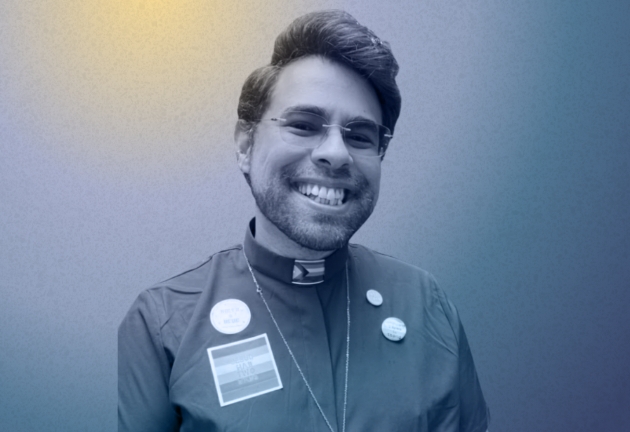
Chris Kanowitz
After years of formation and ordained ministry, Chris Kanowitz found himself searching for a way to serve with greater integrity…

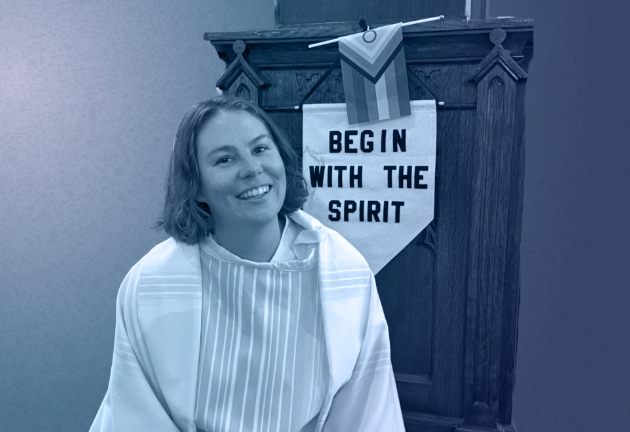
Some calls unfold over a lifetime. Annie Girresch reflects on the people, experiences, and moments of grace that led her to embrace her vocation as a Roman Catholic Woman Priest and answer God’s call with courage.
—
My call to ministry started at a young age, though I didn’t know that’s what it was at the time. When I was in eighth grade, my Catholic school music teacher invited me to be part of the music ministry. This began my love for liturgy, for its power to help the community move through times of joy and sorrow together. At my parish, we celebrated Sunday mass in the school gym because there wasn’t enough room in the church for all the families. I played my flute and sang in that choir. I didn’t realize it at the time, but this shaped my imagination of who and where God is—not just inside the walls of a church building but infusing our “ordinary” spaces with the Sacred.
As a high school student, I went to a summer camp for Catholic youth called “Music Ministry Alive.” Teens from all over the country received formation and mentorship in the skills needed to bring the liturgy to life for the people. When I went back to my Catholic high school after having this experience, I brought that creativity with me. My friends and I started a chapter of the “Shalom Club” for peace, justice and the Earth. We got our whole school to participate in special liturgies for social change, celebrating the four United Nations holidays of International Women’s Day, Day of Peace, Human Rights Day, and Earth Day. When I think back on it, I can’t believe we were that bold—what teenagers enjoy inviting their peers to go to extra church services? Well, it might be a sign you have a call to ministry.
By the time I had graduated high school, I was recognized by the Archdiocese of St. Louis twice for leadership. I don’t say this to boast; to be honest, at the time, I was kind of embarrassed by the attention. I wasn’t interested in accolades. But later, when I was coming to terms with my call, I had to look back and realize: if I had been a boy, I would have been on the short list for recruitment to the priesthood. My call to ordained ministry was so obvious.
I started to question women’s role in the church as a freshman at Marian University. I attended this Franciscan college on a San Damiano scholarship—a program in the tradition of St. Francis’ call to “rebuild my church.” The idea was to train lay people in theology and pastoral skills, so we could be prepared to step into parish roles that were being left vacant by dwindling vocations to the priesthood and religious life. I was given access to retreats, spiritual formation, a spiritual director, and theology classes. I was invited to reflect on how, like Francis of Assisi, God was calling me to “rebuild my church.” I don’t think they knew how seriously I would consider that question. My first semester, I wrote my Theology 101 term paper on why women should be ordained. I looked at the theology, studied it in earnest. It didn’t make any sense to me. I got an A on that paper for my ability to reason theologically. But my professor calmly and pastorally explained to me that I was wrong. This was so symbolic of the existential confusion that exists for Catholic women; we are good enough to get the job done, yet somehow intrinsically disqualified.
Over the course of my studies, I grew disillusioned with pastoral ministry. I was beginning to see that there was no place for my full womanhood in the church. I was coming to terms with my queerness, and I knew that coming out would put a target on my back. I shifted my energy to focus on the ministry of social justice, joining a campaign to unionize the campus food service and maintenance workers. I moved into the Indianapolis catholic worker house.
During this time, I suffered a sexual trauma. In the aftermath, I had no idea how to make sense of what was happening to me. Surrounded by a religious culture of sexual purity, I was totally isolated. I didn’t feel safe to talk about sex, let alone what had happened to me. I started to go into a dark place inside my own spirit. The religion that had always helped me move through Life suddenly had nothing to offer me but silence—it could not help me process my pain. This was devastating to me, emotionally and spiritually.
I started going into the woods to listen to God. I heard Her speaking to me in the trees, consoling me. She told me that I was not a man; that I did not need to try to live in a man’s world. She told me that I was made in Her image.
After graduation, I went to the School of the Americas protest. I’d attended other times as a college student but always felt restricted by the fact that I was on a Catholic scholarship. I didn’t want to get into trouble. This time, I went as an individual. I wandered into a mass led by a woman priest. Seeing a woman in vestments, hearing her proclaim “The Lord be with you. . . .” broke something open inside me. I was a blubbering mess. A kind stranger offered me a tissue. “I know,” was all she said.
I left the church for a time and wandered in the wilderness. I took up yoga and meditation. I learned how to be alone, how to listen to the wisdom of my own body. I met some helpful guides who helped me begin to heal. I continued with organizing and activism, but something was missing in my spiritual life. I couldn’t bring myself to go inside of Catholic churches—it hurt too much. I felt like an orphan.
The day after Donald Trump’s victory in the 2016 election, I woke up startled. It was like I could hear a gong sounding off in my heart. I heard the word “priest.” That I needed to respond to the growing political crisis I was witnessing with liturgy. It made no sense. I wasn’t even Catholic anymore! How could I live that out?
One day, a few months later, I was waiting tables for the lunch shift at my restaurant job. A man came into the restaurant with a book labelled “United Church of Christ.” I struck up a conversation. It turned out he was a student at Eden Theological Seminary. He turned to me and said, “have you ever thought of going to seminary?” I admitted that yes, I had. He gave me the contact information for the admissions counsellor, and I went as soon as I got off work. This was the sign I needed. I enrolled the following semester. I was 26 years old.
My first year of seminary, I had no idea what denomination I was. I was attending a seminary of the United Church of Christ, but there were students from many traditions – Presbyterian, Lutheran, Methodist, Episcopalian. There were ordained women and out gay people everywhere. I felt liberated! And, out of place; like I was living in someone else’s house. I got assigned to an internship as a faith-based community organizer, gathering signatures to raise the minimum wage. Since I was familiar with the Catholic world, they sent me to collect signatures at Catholic parishes. I found myself sitting in back pews, weeping. I had no idea how much grief there was in my heart; I longed to come “home,” but I didn’t see how I could do that and fully be my whole self.
I confided about this conundrum to a friend, who introduced me to an RCWP. I went to an RCWP-led mass for Holy Thursday, and I heard the word “Home” in my heart.
That was seven years ago. In those years, I completed my M.Div. and made my way—slowly, discerningly—through each unit of preparation of the RCWP program. I co-founded an ecofeminist priestess collective called “Sophia Rising.” I did CPE and became a hospice chaplain. At each step, I was haunted by self-doubt. I had to make my way through it slowly.
In my final two years of hospice chaplaincy, I worked for a Catholic healthcare organization. I started out terrified, hiding my identity as an RCWP. I was afraid that I would be fired for my affiliation with this “heretic” movement. But slowly, as I built relationships with the staff, patients and families, I began to open up about it. I found that the response was overwhelmingly positive. My coworkers, many of them recovering Catholics, were thrilled to hear about this. Sharing the “good news” of women’s ordination with my coworkers deepened my ministry to them.
As many chaplains experience, I felt ordained by the patients themselves. In four years of hospice chaplaincy, I was called upon to preside at nearly every sacrament. I did baptisms, anointings, and even a wedding for the dying. I heard innumerable confessions. I shared the Eucharist. I brought liturgy to the patients, allowing them to attend mass one last time before they died. I prayed with people moments before and after they transitioned into the Great Beyond. I counselled people who had been hurt by the church, yet needed a trustworthy spiritual confidante in their final days. I helped those people reach back into the faith that was always theirs, the faith they needed to cross the threshold. Every one of them taught me so much.
As I stand on the precipice of my priestly ordination, I know I am probably over-prepared for this. As a queer Catholic woman, I had to heal from a lot of internalized sexism and homophobia that caused me to doubt myself. I had to fortify my inner world with dedicated spiritual practice, and I had to shore up my psychological wellbeing. I knew that choosing to say “yes” to this call would require a lot of me.
Today, I prepare to cross the threshold into what lies ahead. I’m not certain what ministry will look like. As RCWP, we are not assigned a ministry after ordination—we discern what ministry is emergent. I know that I have a longing to nurture the spiritual life of intergenerational community. I love being a Spiritual Director, listening with deep presence to individuals on the spiritual journey. I trust that the rest will unfold. As we say in the Rite of Ordination, “Here I am. I am ready.” Spirit will do the rest!